How to Lead AI Adoption Across Four Levels of Change
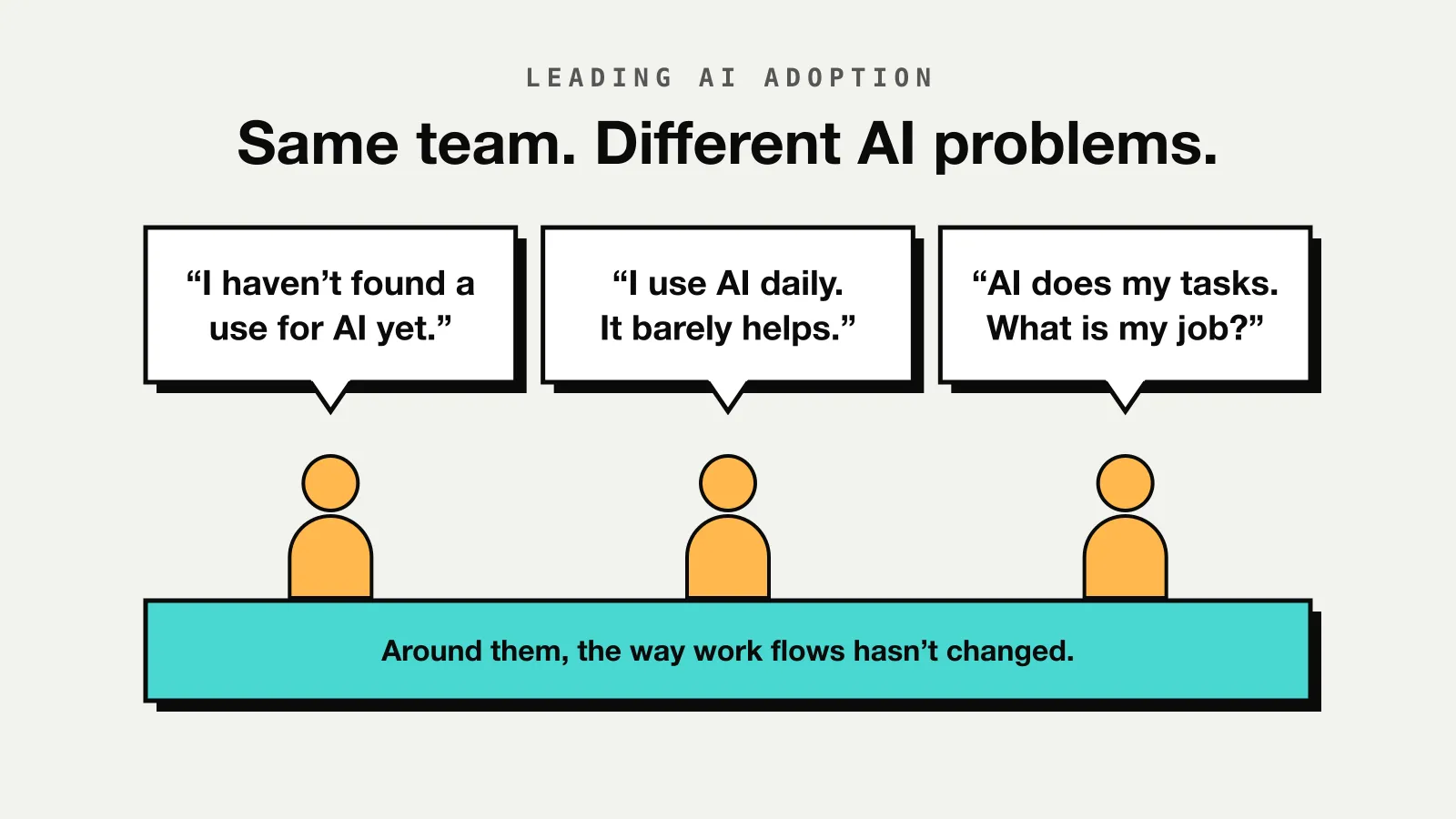
Across your teams, one person is still looking for a useful way to apply AI. Another uses it daily but gets limited value. A third delegates whole tasks to agents and is already wondering what their own role has become.
All three need support at the same time.
Early adopters show how high the ceiling can go. The organizational challenge is to raise the floor: spread useful AI capability across dozens or hundreds of employees.
I see four levels of change that organizations need to support. They overlap, and people will not move through them in a fixed order. The first three concern the person's work; the fourth concerns the system around them.
1. Getting started with AI needs a reason, an example and time
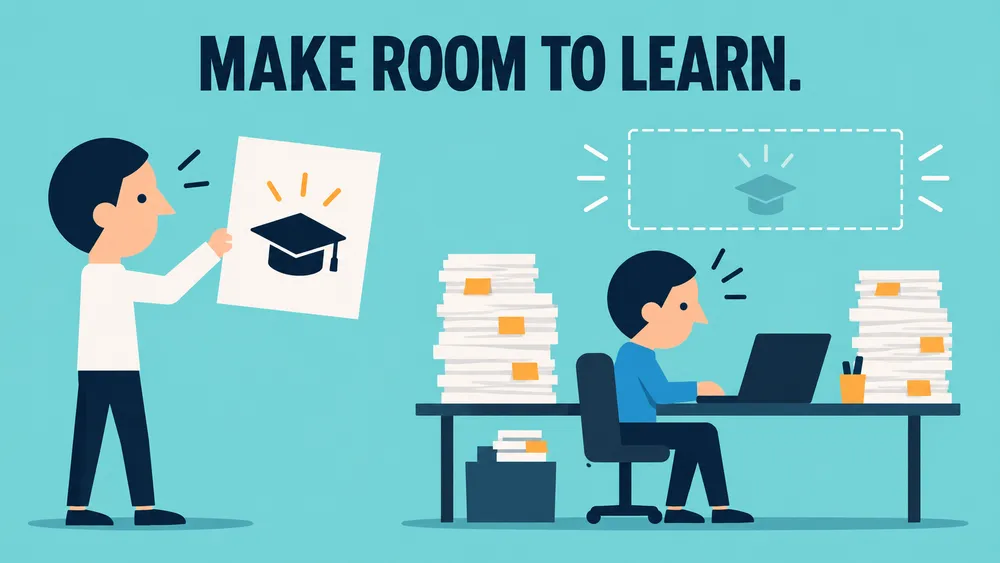
Getting started takes effort before it produces a benefit. People need a useful task to try, a clear understanding of what is allowed, and time to learn during the working day.
Permission matters. If every hour is already committed, telling someone to experiment does little. Making learning part of everyday work means adjusting delivery expectations to make room for it.
People also need a reason to make the effort. A useful starting point is a task they recognize: something repetitive, frustrating, or difficult that AI might help them handle. The benefit needs to become concrete enough to justify working through the awkward early attempts.
There is a longer-term reason too. As work changes, keeping professional skills relevant requires learning. Leaders should be clear about the capabilities they expect people to develop and provide a realistic opportunity to develop them.
Their own behavior matters here. A leader who shows how they use AI, including where it fails and how they check its work, makes the expectation tangible. People can see what learning looks like in practice.
HR can help establish these conditions. Managers have to make them real in daily work.
2. Making AI useful happens close to the team
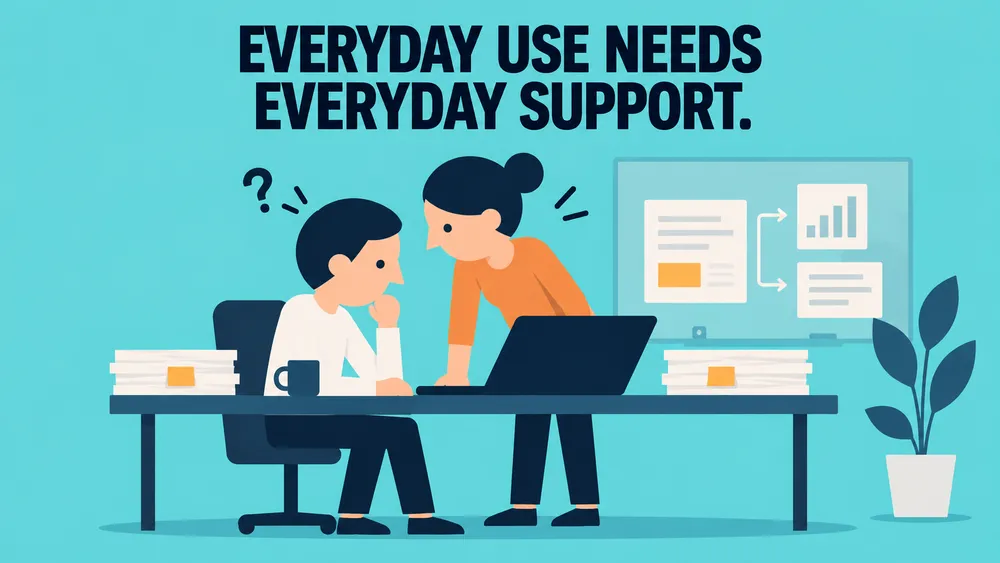
Getting someone through their first experiment is only a beginning. The next challenge is helping them develop a useful, repeatable way of working.
This is where I think support needs to move close to the team.
A large company-wide discussion channel can be useful for sharing discoveries. But asking a basic question in front of hundreds of colleagues can feel uncomfortable, especially for an experienced professional who is used to being the person with answers.
A colleague nearby changes that. Someone who understands the project can help with a real task when the question appears. They can demonstrate how they provide context, refine instructions, challenge an answer, or decide that AI is the wrong tool for a particular job.
That is the value I see in team-level AI champions. Their example is present in everyday work. People learn by seeing a colleague solve a familiar problem and then trying it themselves.
Those champions need support too. A small group of more experienced specialists can help them with difficult cases and spread useful practices across teams. Managers need to allocate working time explicitly for helping others, or the responsibility simply becomes extra work for the most enthusiastic people.
When a team finds a useful way of working, capture the task, the context it needs, and how the result is checked. Let another team try and adapt it, then make it part of normal work where it helps. Record failures too. This turns individual discoveries into shared capability and reduces dependence on the same few people answering every question.
The learning itself should develop judgment. People need to understand what context a task requires, how to work iteratively, and how to validate the result. Trust should match the task and the reliability of the output. Knowing when to stop or check more carefully is part of being capable.
Motivation continues to matter. If using AI repeatedly creates more correction work than benefit, people need practical help finding out why. As I have learned from making AI workflows available across a team, availability alone does not make them useful. More encouragement alone will not fix that experience.
3. When AI changes the role, people need more than training
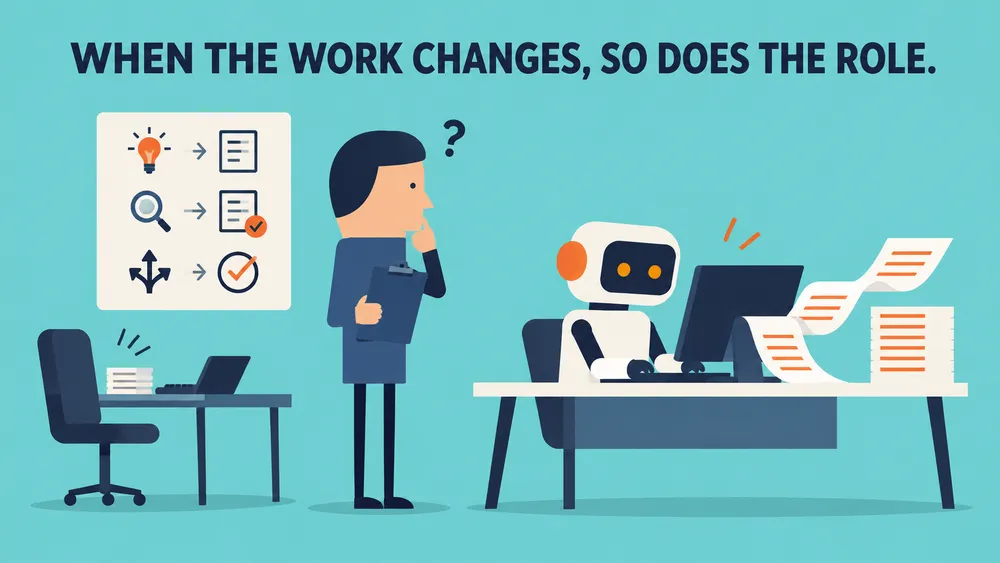
In my own work, I have noticed how AI changes the job itself. More of my attention now goes toward defining what needs to be done, delegating, checking results, and making decisions.
That requires a different set of skills. A person can be excellent at performing a task and still need practice explaining its boundaries, defining an acceptable outcome, and evaluating work produced by an agent.
I have also learned that adapting to a changing role can be personally difficult, even when AI is working well. As it took over more of the work I had built my professional identity around, I had to reconsider where my expertise belonged, what I would be valued for, and what my future role could be.
A course on agent tools addresses only part of that situation. People also need credible opportunities to develop into changing roles, conversations about their future, and recognition of the expertise they still bring.
Technical competence does not make someone immune to uncertainty about their professional value. A skilled AI user may need substantial support with the change in their work.
There is also the question of workload. I have noticed that AI can help me get more done while making my working day more demanding. Some of the easier tasks disappear, leaving more time spent checking work and making difficult decisions.
A system can produce more while the human running it becomes more exhausted. Managers need to notice that distinction and adjust the work accordingly.
HR has a substantial role here: developing career paths, supporting reskilling, and revisiting how performance is recognized as the work changes. Managers also need preparation for conversations about professional identity, uncertainty, and workload. Their own development needs attention alongside their teams'.
4. Faster work moves the bottleneck into the organization
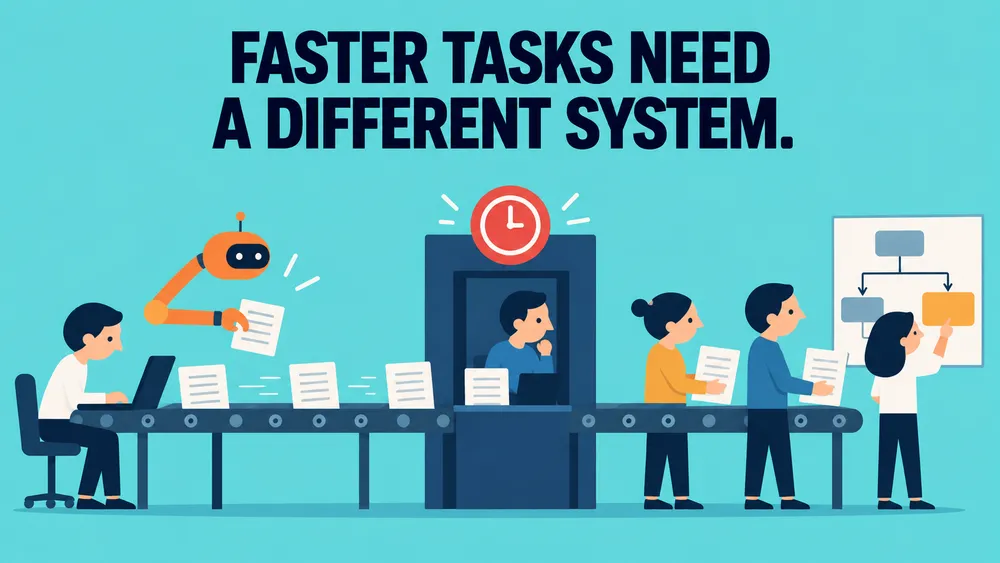
When AI changes one person's work, it raises questions about skills, workload, and role. When it changes how work moves between people, teams, and systems, it becomes an organizational design question too.
In my own work, I have found that making one task faster often moves the delay somewhere else. Work may get done sooner but then wait for someone to check it or make a decision. Improving one part of the process exposes the next limitation.
At that point, the organization needs to reconsider workflows, dependencies, and responsibilities across teams. Which decisions need human judgment, and who has the authority to make them? What can proceed within agreed boundaries? Who is accountable for the outcome?
I have learned that handing work to AI also requires making the rules around it explicit. Things I understood from experience had to be written down: what must always be checked, what AI may decide, and when a person needs to step in.
Those boundaries also need to be enforced through system permissions and approval steps. People need a place to experiment where a mistake cannot directly affect live operations.
Business and technology leaders need to own those decisions. Managers put the new ways of working into practice. HR helps shape the roles, skills, management practices, and incentives around them.
Managers' goals need to make room for this responsibility. Alongside delivery, agree what progress in team capability and ways of working should look like from the team's starting point. If delivery is the only expectation that counts, learning time will keep losing to the next deadline.
For example, an organization may encourage people to delegate tasks to AI while continuing to reward them mainly for doing those tasks themselves. That creates conflicting expectations. Career progression and performance discussions need to recognize the value of defining the right work, exercising judgment, and preventing mistakes.
Limited AI use should not automatically be treated as an individual skills problem. Unclear rules, missing context or documentation, restricted access, and slow approvals can prevent a capable person from using their skills. Before prescribing more training, leaders need to examine those conditions.
Redesign also means asking what useful work becomes possible that the organization could not previously justify or deliver. Some experiments should explore that possibility, even when there is no existing process to compare against.
Follow progress through normal management, not AI scores
Support needs to fit the person's situation. I would connect it to existing one-to-ones and development discussions. Managers can use three simple questions:
Where is this person with AI now?
What is holding them back?
What would be a reasonable next step?
To understand the organization as a whole, combine a short staff survey, aggregated usage signals where available, and team results. The survey can ask whether people:
- can use AI independently in their work
- can evaluate its output
- get useful results, and what prevents them from doing so
- find that AI makes their workload easier or more demanding
Repeat the same core questions over time to see what changes. Look at differences across teams and starting points: an improving average can hide people who are getting little support or benefit. The aim is to understand where capability is spreading, where support is needed, and which barriers recur across the organization.
Aggregated usage signals can help show whether use is spreading and moving toward broader tasks, where the tools provide that information. These signals should describe patterns across groups without inspecting individuals' conversations. They complement people's accounts of their work; they do not establish competence or value on their own.
At the team level, compare delivery, quality, lead time, rework, useful capacity, and workload with the team's own starting point. Use these results alongside the survey and usage signals to check whether growing capability is translating into better work. Individual support stays in normal manager conversations, without separate AI scores or tests.
Include AI operating costs and the time spent reviewing and correcting its work when assessing the benefit. Give exploratory work an explicit budget, so people can test ideas whose value is not yet known.
In the AI coaching program at Oma Säästöpankki, the team measured time savings in real tasks and identified where human review was still necessary. Both were useful results.
Usage statistics alone cannot demonstrate value. Raising the floor means useful AI capability is spreading beyond the stars and showing up in how work gets done.
Support all four levels at the same time
Wherever people are today, make sure support exists at all four levels:
- Help people start: give them a reason, an example, and time to learn.
- Help people develop: keep practical support close to everyday work.
- Help people adapt: support changing skills, identity, careers, and workload.
- Change the system: align workflows, responsibilities, decision rights, and incentives.
Leaders need to keep both ends of this experience in view: the person who still needs help getting started and the person whose job has already changed. Both need support, and the organization needs to evolve as they develop.
AI adoption doesn't end when people start using AI. As their work changes, the organization has to change with them.