AI Optimized My Throughput. It Did Not Optimize Me.
A first-person account of AI brain fry, decision fatigue, and becoming the human bottleneck in an AI agent workflow.
My AI agents increased my output by more than 10x.
My workdays got heavier, not lighter.
I have spent the past year building software almost entirely through AI agents. On a normal day, several agent teams write code, run tests, review implementations, and solve small problems without me.
I wrote the broader story of how that year changed my work and role in AI took my job. Twice in one year. I still have one. This article is about one consequence I did not expect: the system became more productive while my own work became mentally heavier.
Technically, this is exactly what I wanted.
The agents can work for hours on their own. The checks are green. The factory keeps moving.
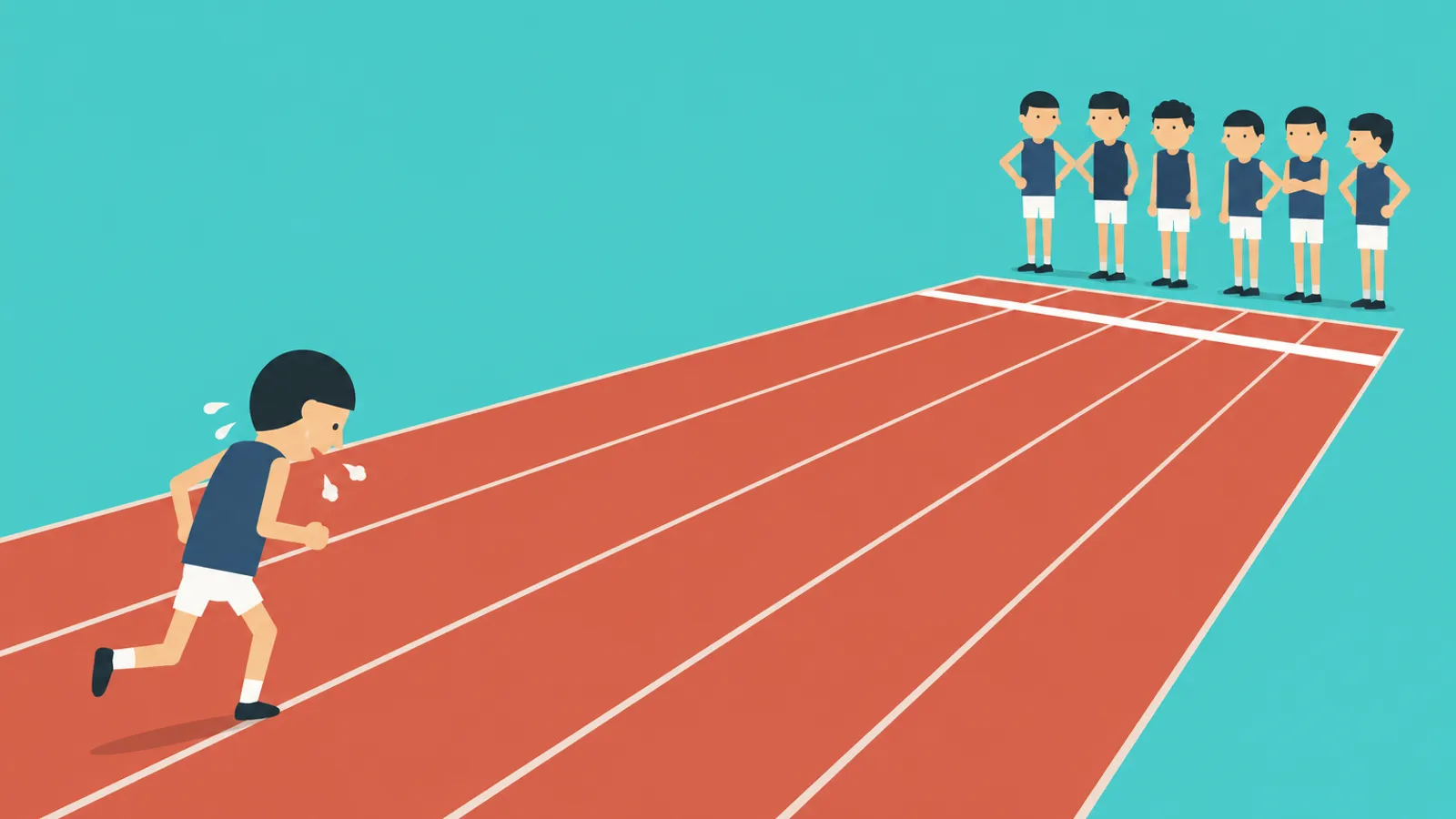
And somehow, I feel like the last kid finishing a race at school. Everyone else has finished. The whole system is waiting for me.
If AI removed so much work, why did the work feel harder?
The answer was in what it removed.
AI removes the easy work first
The agents handle implementation details with reasonably clear answers. By the time something reaches me, it is usually a decision they cannot make.
A product trade-off. An architectural choice. A user experience decision with no objectively correct answer. A call that requires knowing the customer, the business, the history of the system, and why we are building this in the first place.
AI did not remove work evenly. It filtered out the small and straightforward parts and left me with the work that requires the most context and judgement.
Before, a development day contained different levels of difficulty. Writing, testing, fixing, and thinking were mixed together. The easier work created space between difficult decisions.
That space is mostly gone now.
The factory handles the small packages. Only the heavy ones reach me.
This is the first thing AI productivity numbers miss. They measure how much the system produces. They do not show the cognitive weight of the work left for the person inside it.
What AI brain fry felt like for me
One difficult decision can be satisfying.
Six unrelated difficult decisions arriving from six different agent teams are something else.
An agent stops at an architectural question. I reload the task into my head, understand what has happened, consider the consequences, and make the call.
Then I switch to the next agent.
Different feature. Different customer need. Different trade-offs.
The agent experiences a short wait. I experience a complete context switch.
Multiple teams. Multiple contexts. Only the hard decisions.
This combination of AI decision fatigue, cognitive overload, and constant context switching is increasingly described as AI brain fry. The phrase sounds almost funny. The experience is not.
AI agents can parallelize execution. Human attention still works one problem at a time.
The hours did not increase. The amount of judgement packed into each hour did.
AI optimized my throughput. It did not optimize my cognitive load.
How I became the human bottleneck
At first, the bottleneck was writing code.
When the agents took over most implementation, the bottleneck moved to reading and reviewing their work.
I built testing, independent validation, and review into the factory. I no longer needed to read every line before the system could continue.
The bottleneck moved again.
Now the agents rarely wait for technical execution. They wait for my decisions:
- What should we build next?
- Which trade-off is acceptable?
- Is this the right direction for the product?
The factory can execute more quickly than I can decide what it should execute.
I had become the slowest part of the system I built.
That was difficult to accept. Being the human bottleneck felt like I had become worse at my job.
For most of my career, being good at the work meant solving problems and keeping things moving. AI took over much of the execution, but I was still evaluating myself using the part of the work it had replaced.
The work had moved. My definition of competence had not.
My value was now in judgement, direction, and deciding what was worth building. That work is slower because it depends on context, includes responsibility, and often has no answer a test suite can verify.
Becoming the slowest part did not mean I had become the least valuable part.
Not every human bottleneck should be removed
I spent much of the year trying to automate myself out of the way. Often, that was the right move.
Some human bottlenecks are simply badly designed work: an unnecessary approval, missing documentation, unclear ownership, or a question asked during execution that should have been settled during planning.
Those should be fixed.
Other waits exist because the decision belongs to a person. Product direction. Architecture. Security. An irreversible action. A trade-off where the technically clean answer is wrong for the business.
Those are not always defects in the workflow. Sometimes they are where human judgement enters.
| Type of bottleneck | What it means | What to do |
|---|---|---|
| Accidental queue | Work waits because information, ownership, or process is unclear | Redesign or automate it |
| Intentional judgement point | Work waits because a person should own the decision and its consequences | Design it into the system |
This is the distinction that matters in any human-in-the-loop AI system.
The goal is not to make sure AI never waits for a human. The goal is to decide which waits are waste and which are responsibility.
A four-question audit for your own work
It is easy to notice that output went up. It is harder to notice how the work left behind changed.
These are the questions I wish I had asked earlier:
- What did AI remove from my day? Did it remove repetitive work, or also the lighter tasks that created space between difficult decisions?
- What kind of work reaches me now? Count its cognitive weight, not only the number of tasks.
- How many contexts am I carrying? Parallel agent capacity is not the same as human attention capacity.
- Where does the work start waiting? Is it an accidental queue or a decision that genuinely requires human judgement?
There is a fifth question underneath all four: am I still measuring my competence through visible execution, even though my value has moved elsewhere?
Your contribution may now be preventing the wrong work, choosing the direction, recognizing an unacceptable trade-off, or providing the context that makes hours of autonomous AI agent work useful.
That work can look slower while creating more value.
What leaders and HR should look for
AI brain fry is not only an individual productivity problem. It is a work-design problem.
The obvious metrics improve first: more output, shorter delivery time, more tasks completed by one person, and higher AI tool usage.
None of them show the work that moved onto the employee. They do not show AI decision fatigue, repeated context switching, or whether one expert has become the approval point for several parallel workstreams.
Licenses and AI training teach people how to use the tools. They do not redesign the work around them.
Organizations adopting AI agents should examine four things:
1. The work left for people
Ask what AI removed and what it concentrated. Has the work become lighter, or have the same hours become more cognitively intense?
2. Parallel workload
Track how many unrelated AI-assisted workstreams require the same person's attention. An agent working independently can still add to a person's cognitive load if it can interrupt them at any time.
3. The new meaning of good performance
If employees are rewarded for visible execution after their value has moved to judgement, they will try to match the machine at the thing the machine does best.
Good performance may now mean making fewer but better decisions, preventing unnecessary work, giving precise direction, and knowing when AI should continue or stop.
4. Psychological safety around cognitive limits
People need to be able to say:
- I cannot hold all these contexts at once.
- This number of parallel agents is reducing the quality of my decisions.
- I do not have enough information to approve this safely.
- This decision should not depend on one person.
Without that safety, the AI productivity dashboard stays green while human judgement quietly gets worse.
Leaders, domain experts, and HR should design the decision boundaries with the people doing the work. Which decisions can AI settle? Which require a person? Who owns the consequences when the system acts?
These are questions about job design, not only technology.
The system got faster. I did not.
My agents do not get tired after the fifth architectural decision of the day. They do not need time to recover from a context switch.
I do.
That does not make the human part a defect.
AI productivity should not be measured only by how much faster the system runs. It should also be measured by what kind of work reaches the human, how often it reaches them, and whether that way of working is sustainable.
The goal is not to remove the human from every bottleneck.
It is to decide which waits are waste, and which are where human judgement belongs.