What a software factory taught me about AI strategy for law firms
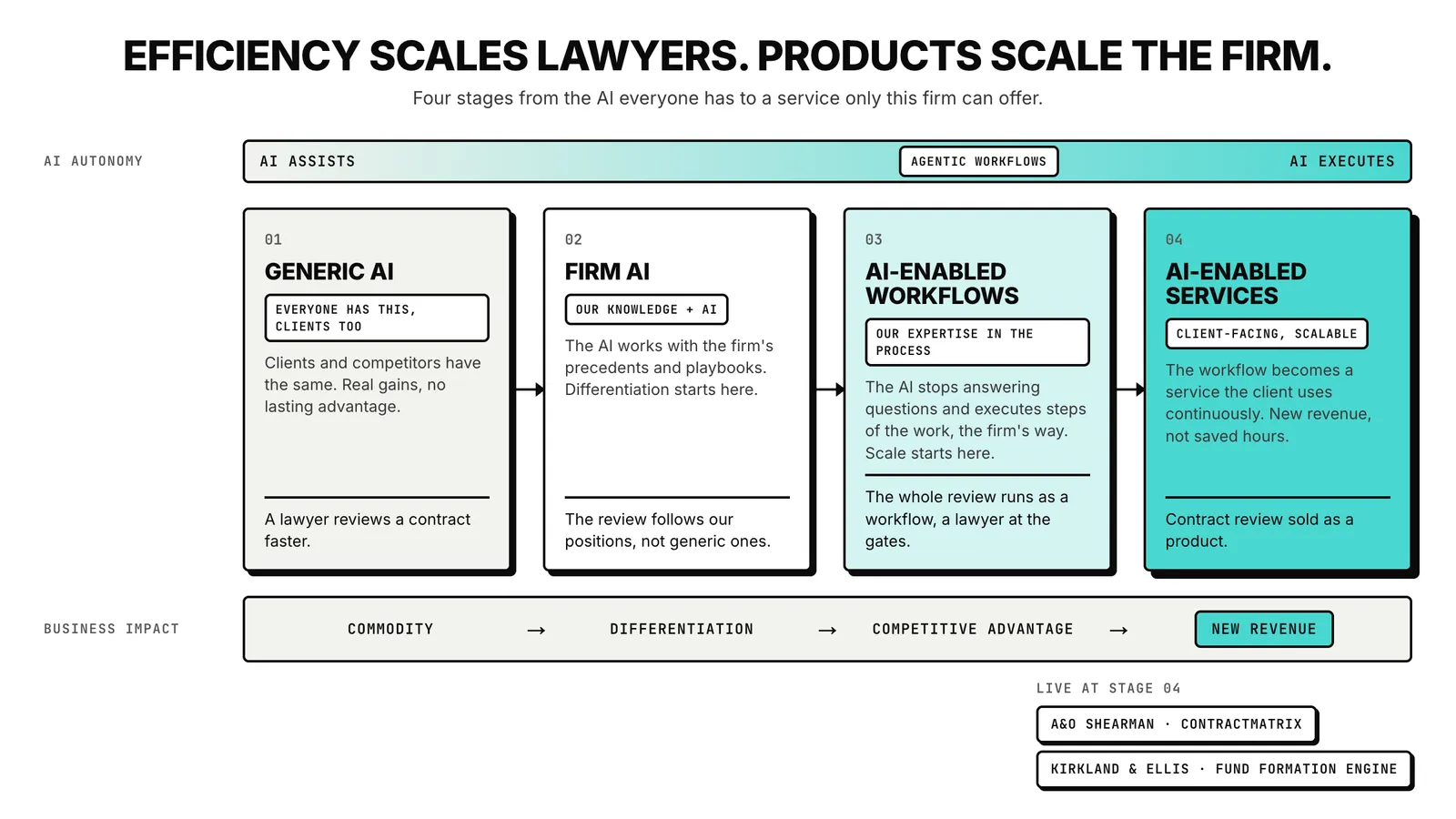
Yesterday I published a new resource page: an AI strategy for a law firm, written as nine decisions for the partners.
I am not a lawyer. I build software in a factory where AI agents write every line of code and I make the decisions. The reason I wrote a strategy for law firms anyway is that I have watched this once already. The shift I lived through in software is now starting in legal work, on the model side and on the service side, one step behind and with the same shape.
The model was never the advantage
Two years ago the question in software was which model to use. Claude or GPT, and which version. That question stopped mattering fast. Every developer got the same model, and every model got better every quarter.
What separated a team that shipped from a team that produced drafts was everything around the model: the rules the agents work under, the specs they are held to, the validator that has to pass before a commit, the memory that carries what was learned into the next task. I call that the harness. The model is a replaceable part inside it.
Same model. Same tools. Different harness, different output.
Then I started talking with lawyers and law firms about AI, and the same picture kept coming back in different words.
| In my software factory | In a law firm |
|---|---|
| Foundation model (Claude, GPT) | Foundation model, or Harvey and Legora built on one |
| Agent rules and skills | Playbooks and the firm's positions |
| Locked specs and acceptance criteria | Precedents and past matters, in a form AI can read |
| Validator that must pass before a commit | A lawyer at the gates of the workflow |
| Memory written at every gate | Institutional knowledge that stays with the firm |
The first row is bought, on both sides, and it is the same for everyone. Everything under it on the left is what I own: nobody sells it, and it works with whichever model is best this quarter. Everything under it on the right is what a law firm could own. Most do not yet.
The market is squeezing the middle from both sides
For two years the legal AI story was Harvey and Legora. They packaged what a firm did not want to build: security, integrations to document systems, legal research, ready workflows, onboarding. Harvey raised at an $11 billion valuation (opens in a new tab) in March and is reported to be in talks at $15 billion (opens in a new tab). Legora went from $5.6 billion in April (opens in a new tab) to talks at $10 billion in August.
That packaging is now being attacked from below. In May, Anthropic released Claude for Legal (opens in a new tab): more than 20 connectors to the systems law firms run on, 12 practice-area plugins, and the plugins can be taught the firm's own playbooks and precedents. Anthropic says legal professionals have become the most engaged Claude Cowork users (opens in a new tab) of any knowledge-work function. In September, OpenAI is preparing its biggest push yet into legal (opens in a new tab), with integrations into legal software so ChatGPT stops being a separate window.
And it is being attacked from above. According to the Financial Times (opens in a new tab), about a fifth of large law firms now build or customise their own AI, while still using Harvey or Legora where it pays. Freshfields (opens in a new tab) put Claude inside its own secure platform for 5,700 people and co-builds legal workflows with Anthropic. Kirkland & Ellis committed $500 million (opens in a new tab) to its own platform. A&O Shearman sells its own product, ContractMatrix (opens in a new tab), with Harvey and Azure OpenAI as components inside it.
The specialist platform in the middle is getting thinner from both directions. I have seen this shape before. In software, the model vendors shipped their own coding agents and moved up into the tool layer, and the teams that got the most out of them stopped choosing tools and built their own harness on top. Both moves are now happening in legal, a year or two later: Anthropic and OpenAI moving into legal work is the first, and the largest firms building their own layer is the second.
The client has the same AI
There is one difference from software, and it is the one that should worry a partner most. The companies I build software for do not run a software factory of their own, at least not yet. A law firm's clients are already getting the same AI as the firm.
In Thomson Reuters' 2026 survey (opens in a new tab), 71% of in-house legal professionals expect their outside firms to change their commercial model as AI use grows. Per the FT (opens in a new tab), Goldman Sachs asks its law firms to quantify their AI savings and uses the number in fee negotiations, and Morgan Stanley is putting most of its outside legal work out to competitive bids.
So the routine share of what a client buys today moves in-house. What is left is judgment, risk and someone to be accountable. And what is new is whatever the firm can build on its own expertise that the client could not buy before.
Three things software already learned
The news about legal AI is about vendors and the largest firms. The lessons are for every firm, and software has already paid for them.
- The tool decision is not the strategy. Teams that spent a year choosing between coding tools are still choosing. The teams that moved took one real task, ran it two ways, and decided on evidence.
- Own the layer above the model. Rules, specs, validation, memory. In a law firm: playbooks, precedents, a lawyer at the gates, institutional knowledge. Anything built inside one vendor's product is only yours as long as you stay.
- The gain compounds only if it is shared. A faster individual is a productivity gain. A harness the whole team runs on is an asset. The same split is the difference between a faster lawyer and a firm whose expertise scales.
Nine decisions, in the order to make them
The resource page turns this into nine decisions, one per section, each with a picture, the reasoning and the sources behind it. At headline level:
- If everyone has the same AI, where will our competitive advantage come from?
- What will our clients still buy from us, and what could we sell that they cannot buy today?
- What should we own, and what should we buy?
- Which expertise do we make AI-accessible first, and who leads that work?
- Where does our ownership boundary go in the AI stack?
- Which of our expertise could become a service that scales?
- How do we share the AI dividend with clients?
- What does this take to build: what do we build, whom do we hire, and what sits inside the practice groups?
- What do we decide, fund and start in the next ninety days?
Three of them carry the rest. Number two is the market decision, and it comes before any technology. Number five is the ownership decision: the models are replaceable, the knowledge, playbooks and workflows above them must be the firm's and portable. A simple test: if the firm dropped its AI vendor tomorrow, what would be left? Number six is the growth decision: not a lawyer who is faster, but a product the client uses, built from the firm's own playbooks the way ContractMatrix was. Number eight came in after the first version: the firms already doing this built a layer between the lawyers and the technology, Linklaters (opens in a new tab) with 20 AI lawyers placed in its practice groups. That is a hiring and organisation decision, not an IT one, and it is what a software team learns when it stops buying tools and starts building its harness. The full argument for each is on the resource page.
What surprised me
The pace. Linklaters went from recruiting 20 AI lawyers to launching a team that builds AI solutions for clients in six months. Kirkland announced its $500 million programme and a client-facing platform a week apart. Six to twelve months of thinking is already slow. Software went through the same year, and the teams that used it for evaluation came out of it with a comparison sheet, not a harness.
The other surprise was how little of this is about technology. A partner does not need to know what retrieval or a vector database is. One sentence is enough: if twenty years of a partner's expertise exist only in that partner, AI cannot multiply it. If it is made accessible, the same expertise reaches every junior, every practice area, and eventually a service sold to the client.
Without that, AI makes individual lawyers faster. With it, AI scales the firm.
What was documented in software over the last two years is now the news about law firms. The full page is AI strategy for a law firm. The model is the commodity. The firm's expertise is the product.
Sources
- Anthropic goes all-in on legal: 20+ connectors and 12 practice-area plugins (LawSites) (opens in a new tab)
- Claude for the legal industry (Anthropic) (opens in a new tab)
- OpenAI is about to make its biggest push yet into the legal industry (Business Insider) (opens in a new tab)
- Legora targets $10bn valuation as Harvey eyes $15bn (Lawyer Monthly) (opens in a new tab)
- Legora hits $5.6B valuation (TechCrunch) (opens in a new tab)
- Law firms seek bespoke differences in legal AI (Financial Times) (opens in a new tab)
- Freshfields and Anthropic co-build AI legal workflows (opens in a new tab)
- Kirkland to spend $500 million on its own AI platform (Reuters) (opens in a new tab)
- Linklaters launches 20 AI lawyers, November 2025 (opens in a new tab)
- Linklaters launches Applied Intelligence, May 2026 (opens in a new tab)
- Kirkland & Ellis and Palantir: fund enterprise platform, June 2026 (opens in a new tab)
- A&O Shearman: ContractMatrix launch with Microsoft and Harvey (opens in a new tab)
- Wall Street banks push Big Law to cut fees because of AI (Financial Times) (opens in a new tab)
- Future of Professionals 2026, legal report (Thomson Reuters Institute) (opens in a new tab)